
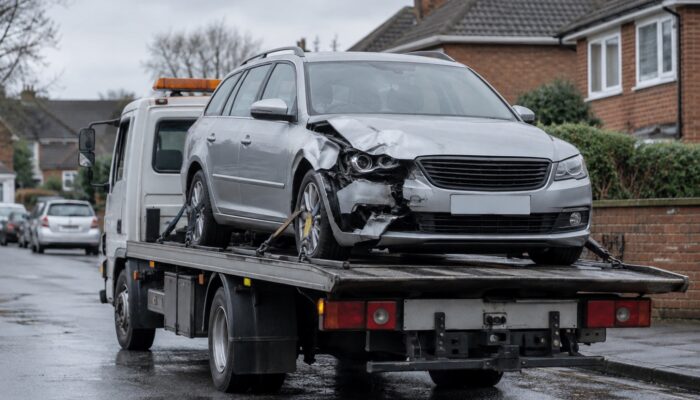
What is a total loss in car insurance?
A total loss is an insurance term for a vehicle that the motor insurer treats as a complete claim rather than repairing it. The Financial Ombudsman Service says insurers sometimes call a write-off a “total loss”, so the two expressions are often used to describe the same outcome. Financial Ombudsman What is GAP insurance? explains the product itself.
The important point is that “total loss” does not necessarily mean the car has been destroyed. A vehicle can become a total loss because serious damage makes repair uneconomic, but it can also become a total loss because it has been stolen and never recovered.
That second situation is easy to miss. A stolen car that is never found can be a total loss even though nobody has inspected damaged bodywork, calculated a repair bill or assigned it a damage category. Financial Ombudsman
The phrase comes from insurance terminology. Rather than dealing with a partial loss by paying for repairs, the insurer treats the claim as a loss of the vehicle as a whole and settles it according to the motor insurance policy.
Total loss, write-off and uneconomical to repair
“Total loss” and “write-off” are closely connected terms, but other phrases can appear during a claim as well. Understanding what each means makes correspondence from an insurer easier to follow.
- Total loss means the motor insurer is settling the claim on the basis that the vehicle has been lost as an insured asset rather than simply repaired.
- Write-off is the common term for a vehicle the insurer has decided to treat as a total loss.
- Uneconomical to repair means the insurer has judged that repairing the damaged vehicle does not make economic sense when considered against its value.
- Constructive total loss is another term that can be used where a vehicle could potentially be repaired, but the insurer considers repair uneconomic.
“Uneconomical to repair” does not mean that the vehicle is physically impossible to repair. It describes an economic decision made by the motor insurer, which is why some repairable vehicles can still be written off.
It also does not cover every type of total loss. If your car is stolen and never recovered, there is no repair estimate to compare with its value, yet the loss can still be settled as a total loss.
The two routes to a total loss: damage and theft
A total loss vehicle normally reaches that position in one of two broad ways. Keeping those routes separate helps explain why the term is wider than simply meaning “badly damaged”.
Total loss following damage
A collision, fire, flood or another insured event can leave a vehicle damaged. The motor insurer assesses the claim and decides whether to repair the vehicle or treat it as a write-off.
Where repair is technically possible but is not considered economic against the vehicle’s value and the circumstances of the claim, terms such as “constructive total loss” or “uneconomical to repair” may be used. That assessment belongs to the motor insurer.
Total loss following theft
The other route does not require damage at all. The Financial Ombudsman Service specifically identifies a vehicle that has been stolen and never found as one of the circumstances in which it may be written off. Financial Ombudsman
That means a car can be a genuine total loss without being wrecked, crushed or even seen after the event. In a theft claim, the “loss” is the fact that the vehicle has not been recovered, rather than a conclusion about how much it would cost to repair.
Who decides whether a car is a total loss?
Will My Car Be Written Off? What Actually Decides It covers this in full. The decision is made by your motor insurance company. GOV.UK states that the insurance company decides whether the vehicle is written off, and the insurer will also tell you how much it will pay under the claim. GOV.UK
For a damaged vehicle, that decision can involve its pre-loss value, the nature and extent of the damage and the economics of repairing it. An insurer may use engineering evidence and vehicle valuation information when reaching its decision.
Insureworks has no part in that assessment. Insureworks Ltd is an appointed representative of Your Company Matters Ltd and distributes GAP insurance on a non-advised basis, while Financial & Legal Insurance Company Limited is the insurer of the GAP policies. Insureworks does not underwrite the GAP insurance, does not pay GAP claims, is not your motor insurer and does not decide whether your vehicle is a total loss.
The detailed steps after a write-off decision are separate from the meaning of the term itself. Our guide to what happens when your car is written off covers that process in more detail.
Is there a fixed total loss threshold in the UK?
There is no fixed UK percentage at which a car automatically becomes a total loss. There is no universal rule saying that once repairs reach a particular percentage of the vehicle’s value, every insurer has to write the car off.
The decision is made by the motor insurer in the circumstances of the individual claim. Different policies and claims can involve different considerations, so a percentage quoted on a forum, comparison site or social media post is not a general UK total loss rule.
This distinction matters because “uneconomical to repair” is an insurer’s assessment, not a national mathematical threshold. Our separate guide answering “will my car be written off?” looks more closely at the factors involved in that decision without turning them into a fixed percentage test.
What does the insurer pay after a total loss?
GOV.UK explains that when a vehicle is written off, the insurance company pays its current value instead of the cost of repairing it. The Financial Ombudsman Service describes the normal settlement basis as the vehicle’s market value immediately before it was damaged or stolen. GOV.UK Financial Ombudsman
Market value is not automatically the amount originally paid for the vehicle. The Financial Ombudsman Service describes market value as the price the vehicle would have sold for at a reputable dealership just before it was damaged or stolen. Financial Ombudsman
That timing is important. The valuation looks at the vehicle immediately before the insured event, not what it cost when new and not necessarily the amount still outstanding under a finance agreement.
A disagreement over value is also different from a disagreement over whether the car is a total loss. The Financial Ombudsman Service considers complaints involving vehicle valuations and write-offs, including evidence such as specialist valuation guides, relevant adverts, vehicle condition information and expert reports. Financial Ombudsman
What are the UK write-off categories?
Insurance Write-Off Categories Explained: A, B, S and N covers this in full. Damage categories describe what can happen to a written-off vehicle after the insurer has classified it. They are not the definition of total loss itself, and a stolen vehicle that is never recovered does not need damaged bodywork in order to be a total loss.
| Category | What it means |
|---|---|
| A | Cannot be repaired. The entire vehicle has to be crushed. |
| B | Cannot be repaired. The body shell has to be crushed, although some other parts can be salvaged. |
| S | Repairable structural damage. The vehicle can be used again if repaired to a roadworthy condition. |
| N | Repairable non-structural damage. The vehicle can be used again if repaired to a roadworthy condition. |
These are the A, B, S and N categories set out in GOV.UK guidance on scrapping your vehicle and insurance write-offs. The category decides what can happen to the vehicle afterwards, and it is recorded against the vehicle rather than against the claim.
A write-off therefore does not always mean that a vehicle can never return to the road. Categories S and N can be repaired and used again if they are restored to a roadworthy condition, whereas Categories A and B cannot be repaired for continued use.
For a fuller explanation of how the classifications differ, see our separate guide to car insurance write-off categories.
What does a total loss mean if the car is on finance?
Car On Finance Written Off: What Happens Next? covers this in full. A motor insurance settlement and a finance balance are two different figures. If your car is declared a total loss while money remains under a finance agreement, the insurer’s settlement is based on the motor policy rather than simply being set at whatever remains outstanding on the finance.
That can matter because the vehicle’s market value may differ from the amount connected with the finance agreement. The precise effect depends on the agreement, the motor insurance settlement and any other relevant cover already in force.
This is also where the distinction between motor insurance and GAP insurance becomes important. GAP insurance is separate from the motor policy and, depending on the particular GAP product and its terms, may deal with a defined difference between the motor insurer’s settlement and another figure such as an eligible invoice price, finance settlement, replacement cost or contract hire liability.
A total loss decision still comes first from the motor insurer. GAP insurance does not turn a repair claim into a write-off and does not give Insureworks or the GAP insurer control over the motor insurer’s decision.
What does a total loss mean for GAP insurance?
If you already hold one of the GAP policies distributed by Insureworks, a total loss is the event that can potentially lead to a GAP claim, subject to the policy terms, exclusions, limits and the motor insurer paying a settlement. The GAP policy is separate from your comprehensive motor insurance and does not replace it.
The policies have different purposes:
- Return to Invoice GAP can respond to an eligible difference involving the motor insurance settlement and the original invoice price or relevant lender settlement, subject to the policy terms and Maximum Benefit.
- Vehicle Replacement Insurance can respond to an eligible difference between the motor insurance settlement and the cost of the defined replacement vehicle, subject to the policy terms and Maximum Benefit.
- Contract Hire GAP can respond to an eligible shortfall between the motor insurance settlement and the remaining lease or contract hire liability, subject to the policy terms and Maximum Benefit.
For these GAP policies, a comprehensive motor insurance policy must be maintained throughout the coverage period. The required claim documents must also be provided within 120 days of the total loss.
There is also an important eligibility restriction. A vehicle that has previously been declared a total loss or write-off is not eligible for these GAP policies, even if it has since been repaired and returned to the road.
Insureworks distributes these GAP policies on a non-advised basis, so the information provided is intended to help you understand the products rather than provide a personal recommendation. Financial & Legal Insurance Company Limited is the GAP insurer and is responsible for the insurance cover, not Insureworks.
What happens to the vehicle after a total loss?
Car Written Off: What Happens Next? covers this in full. What happens physically to the vehicle depends on the type of loss and, for damaged cars, the write-off category. GOV.UK says insurers will usually deal with having a vehicle scrapped where that is required, while Categories S and N can potentially be retained and repaired for further road use if they are roadworthy. GOV.UK
Categories A and B are different because they cannot be repaired for return to the road. A Category A vehicle must be crushed in full, while the body shell of a Category B vehicle must be crushed, although other parts may be salvaged. GOV.UK
There are also DVLA requirements when an insurer writes off a vehicle. GOV.UK explains that DVLA must be told when a vehicle has been written off and sets out the separate steps concerning the V5C and any registration number you want to retain. GOV.UK
A stolen and unrecovered vehicle is different because there may be no vehicle available to repair, retain or scrap. It can still be a total loss, which is why the insurance meaning of the term is broader than the physical condition of a damaged car.
Total loss car insurance FAQs
What does “total loss car” mean in car insurance?
A “total loss car” usually means a vehicle that the motor insurer has decided to treat as a complete insurance loss rather than settling the claim by repairing it. Insurers also use the term “write-off”, and the Financial Ombudsman Service notes that the expressions can refer to the same outcome. Financial Ombudsman
A total loss does not always involve a badly damaged vehicle. A stolen car that is never recovered can also be a total loss.
How does a total loss car insurance claim work?
In a total loss car insurance claim, the motor insurer decides that the vehicle will be treated as a write-off rather than repaired, or accepts a qualifying theft where the vehicle has not been recovered. GOV.UK says the insurer decides whether a damaged vehicle is written off and, when it is, pays its current value rather than the repair cost. GOV.UK
The exact claim process depends on the motor insurance policy and circumstances. Our separate write-off process guide covers the stages that follow the decision in more detail.
Who decides whether a total loss vehicle is written off?
Your motor insurance company makes the total loss decision. Insureworks, the GAP insurer and any GAP policy you hold do not decide whether your motor insurer repairs or writes off your vehicle.
Insureworks is not a motor insurer and does not participate in the total loss assessment. Its role is the non-advised distribution of the relevant GAP insurance products.
Can a stolen total loss vehicle have no damage?
Yes. The Financial Ombudsman Service says a vehicle may be written off because it has been stolen and never found, so physical damage is not required for every total loss. Financial Ombudsman
This is why “total loss” is an insurance claim term rather than simply another way of saying that a car has been badly damaged. The loss can be the permanent loss of the vehicle itself.
Is there a fixed percentage for a total loss car?
No fixed percentage is a UK rule for deciding that every car is a total loss. The motor insurer makes the decision in the circumstances of the individual claim, so percentages quoted online must not be treated as a universal threshold.
A damaged vehicle can be described as uneconomical to repair when the insurer considers the repair uneconomic against the vehicle’s value. That judgement does not depend on one nationally prescribed percentage.
Can a previously written-off total loss vehicle be covered by these GAP policies?
No. A vehicle that has previously been declared a total loss or write-off is not eligible for the Insureworks-distributed GAP policies described here, even where a repairable Category S or N vehicle has subsequently been restored.
That restriction is an eligibility condition for the GAP cover, not a statement that every repaired write-off is prohibited from being used on the road. GOV.UK confirms that Category S and N vehicles can be used again if repaired to a roadworthy condition. GOV.UK