
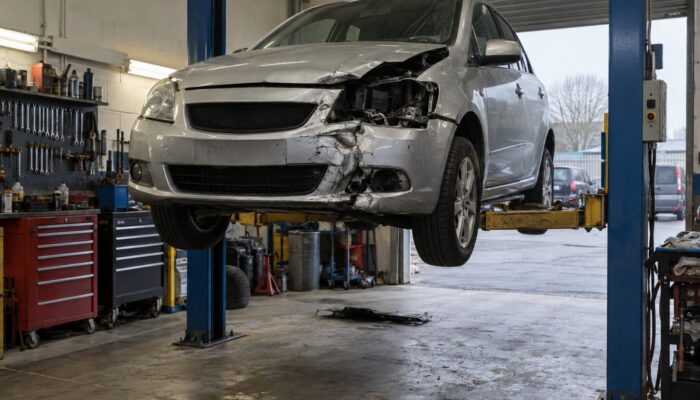
If you are searching for a car insurance write-off calculator UK drivers can use, there is an important limitation to know first. No calculator can tell you whether your car will be written off, because there is no fixed UK write-off threshold and the decision belongs to your motor insurer.
You can compare the estimated repair cost with your car’s pre-accident market value, and that calculation can help you understand the numbers involved. It cannot produce a reliable “repair” or “write-off” verdict because your insurer considers more than one figure before making its decision.
Why there is no UK car insurance write-off calculator that can decide it
A genuine car write off calculator would need to know exactly how your motor insurer assesses total losses, the final repair estimate, the insurer’s valuation of your car, its salvage value and whether the vehicle can be repaired safely. Most of those figures are not confirmed until the claim has been assessed.
There is also no fixed UK percentage at which a car automatically becomes a write-off. GOV.UK is clear that your insurance company decides whether your vehicle is written off and, if it is, how much it will pay you. GOV.UK
What about the “50 per cent” or “60 per cent” rule?
You will often see claims online that a car is written off when repairs reach 50% or 60% of its value. Neither figure is a universal UK threshold, so entering your repair bill into a calculator and comparing it with one of those percentages cannot determine the outcome.
There is one place where a percentage genuinely appears in published guidance, and it is not a write-off threshold. The Financial Ombudsman Service, in its approach to motor valuations and write-offs, notes that most motor policies for vehicles that are new or less than 12 months old will provide a new vehicle where the car is written off within a certain time and the repair cost is more than 60 to 70 per cent of the current list price, which is a new-car replacement trigger and not a write-off threshold.
That figure is the trigger for a new-car replacement under the motor policy. It is not the point at which an insurer decides to write a car off, and the two are routinely confused online. It also applies to list price rather than to the car’s current market value, which makes it a different calculation again.
What does it mean when a car is a total loss?
“Total loss” is the insurance term commonly used for a write-off. It does not always mean a vehicle is physically beyond repair, because a repairable vehicle can still be treated as a total loss when the insurer decides repairing it is not economically sensible.
A vehicle can also become a total loss following theft if it is not recovered. The Financial Ombudsman Service says that, where a vehicle is written off, the motor insurer will usually settle based on its market value immediately before the damage or theft. Financial Ombudsman
This is why a fairly ordinary-looking accident can sometimes lead to a write-off, particularly when the vehicle has a relatively low pre-accident value. Equally, significant visible damage does not by itself prove that an insurer will write the vehicle off.
The four things that really drive a motor insurer’s decision
There is no single calculation that replaces the insurer’s assessment. Four factors help explain why two apparently similar cars can receive different outcomes.
| Factor | Why it matters |
|---|---|
| Repair cost | The insurer needs to establish the expected cost of putting the vehicle back into an acceptable condition. |
| Pre-accident market value | This provides the financial value against which the cost of repairing the car can be considered. |
| Salvage value | A damaged vehicle can still have value if the insurer disposes of it as salvage after a total-loss settlement. |
| Safe repairability | Some damage may make repair inappropriate, while Categories S and N can be repaired and returned to the road if roadworthy. |
Repair cost
The first figure is the estimated cost of repairing the accident damage. That estimate can change as damage is inspected in more detail, so an early garage estimate is not necessarily the figure on which the insurer eventually acts.
The Financial Ombudsman Service looks at repair estimates and engineers’ reports when considering disputes about whether an insurer acted reasonably. It also recognises that further evidence may be needed where the extent or cost of repairs is unclear. Financial Ombudsman
Pre-accident market value
The relevant comparison is normally with the car’s value immediately before the incident, rather than its original purchase price. Mileage, specification, condition, vehicle history and existing damage can all be relevant when the insurer arrives at that valuation.
The Financial Ombudsman Service says it uses specialist motor valuation guides and other available evidence when considering whether an insurer’s market valuation is fair. Comparable adverts and expert evidence can also become relevant, particularly where valuation guides differ significantly. Financial Ombudsman
Salvage value
A written-off vehicle may still have a financial value in its damaged state. The insurer can normally take ownership of the salvage once a full market-value settlement has been accepted, while a policyholder retaining eligible salvage may see its value deducted from the settlement.
The Financial Ombudsman Service says it would normally expect an insurer to provide evidence of the amount it could have obtained for salvage where that amount is deducted. Salvage therefore forms part of the financial picture, but it still does not give you a stand-alone formula for predicting the decision. Financial Ombudsman
Whether it can be repaired safely
The financial numbers are not the whole story. The extent and nature of the damage also matter, including whether the vehicle is repairable and can be returned to a roadworthy condition.
The salvage categories reflect this distinction. Categories A and B cannot return to the road, while Categories S and N can be repaired and used again if they are restored to a roadworthy condition. GOV.UK
How to calculate your repair-cost-to-value ratio
Although it cannot decide the outcome, you can calculate the repair-cost-to-value ratio for your own car. The calculation is estimated repair cost ÷ pre-accident market value × 100.
For example, imagine an estimated repair cost of £4,800 and a pre-accident market value of £9,000. Dividing £4,800 by £9,000 and multiplying by 100 gives a ratio of about 53%.
What does that result tell you?
It tells you how large the estimated repair cost is when compared with the car’s estimated pre-accident value. That can make it easier to understand why an insurer is investigating whether repair or a total-loss settlement is appropriate.
It does not mean a 53% result will be repaired, or that a different result will be written off. The final repair estimate, the insurer’s own market valuation, salvage economics and the nature of the damage can all change the decision.
That is the key limitation of any car insurance write off calculator UK searchers find online. The maths can give you an indication of the relationship between two numbers, but it cannot reproduce your insurer’s total-loss assessment.
Who decides whether your car is written off, and when will you find out?
Your motor insurer makes the write-off decision. You do not declare your own vehicle an insurance write-off, and neither a repair garage, a finance company nor a GAP insurance distributor can make that decision on behalf of the motor insurer.
You will normally find out once the insurer has enough information to assess the damage and decide how it intends to settle the claim. GOV.UK states that the insurer will tell you whether the vehicle is being written off and how much it will pay. GOV.UK
Insureworks has no part in that decision. Insureworks Ltd is an appointed representative of Your Company Matters Ltd and distributes GAP insurance on a non-advised basis, while Financial & Legal Insurance Company Limited is the GAP insurer. Insureworks does not underwrite insurance or pay claims, and it is not your motor insurer.
What happens during an engineer’s inspection?
An engineer’s assessment provides evidence the insurer can use when deciding how the claim will be handled. Depending on the circumstances, evidence can include photographs, repair information and an engineer’s report, with further expert evidence used where the position is unclear.
An engineer’s report can record the damage, estimated repair work, condition of the vehicle and information relevant to its valuation. Pre-existing damage, modifications and vehicle history can also become relevant when the insurer or the Financial Ombudsman Service considers the evidence. Financial Ombudsman +1
The assessment may also identify damage that was not obvious immediately after the incident. This is another reason an initial repair quotation and a simple repair-cost ratio cannot guarantee what the insurer will decide.
What happens if the insurer decides to repair the car?
If the motor insurer decides the vehicle is repairable and deals with the claim by arranging repairs, the vehicle has not been declared a total loss. The insurer then handles the repair claim according to the motor policy and its claims process.
That distinction matters where GAP insurance is involved. Insureworks-arranged GAP cover is designed around an eligible total loss and a settlement from the comprehensive motor insurer, subject to the relevant policy wording, conditions, exclusions and limits.
A decision to repair can still be disputed if you believe the decision or repairs are unreasonable. The Financial Ombudsman Service can consider complaints about whether a vehicle should have been written off rather than repaired, using evidence such as its condition, estimated repair costs and engineers’ reports. Financial Ombudsman
What happens if the car is written off?
Car Written Off: What Happens Next? sets out the full process. If your insurer declares the vehicle a total loss, the next steps depend partly on its salvage category. The ABI salvage code is the motor industry code used for categorising vehicle salvage, including Categories A, B, S and N (see Insurance Write-Off Categories Explained: A, B, S and N).
Category A: The vehicle cannot be repaired, and the entire vehicle has to be crushed.
Category B: The vehicle cannot be repaired, and the body shell has to be crushed, although some parts can be salvaged.
Category S: The vehicle has suffered structural damage but can be repaired and used again if it is returned to a roadworthy condition.
Category N: The vehicle has suffered non-structural damage and can be repaired and used again if it is returned to a roadworthy condition. GOV.UK
For more information about write-offs and related GAP insurance topics, you can browse the Insureworks Article Centre .
GOV.UK also explains the DVLA steps that apply after an insurance write-off. These include telling DVLA when the vehicle has been written off and scrapped, while different arrangements apply if an eligible Category S or N vehicle is being retained. GOV.UK +1
What if you disagree with the insurer’s valuation?
A write-off decision and the amount offered for the car are separate issues. You might accept that the car is a total loss but believe the insurer has placed too low a pre-accident market value on it.
The Financial Ombudsman Service says most valuation and write-off complaints it sees involve disagreements about market value, which it describes as the price the vehicle would have sold for at a reputable dealership just before it was damaged or stolen.
It uses motor valuation guides as an indication of a fair valuation, and where an insurer’s figure is not close to the highest guide value and is not supported by other evidence, it is likely to tell the insurer to use that highest guide value. When assessing whether a valuation is fair, it can consider specialist valuation guides, comparable advertisements, expert evidence, vehicle condition, history and other relevant information. Financial Ombudsman
A complaint normally starts with the insurer, giving it the opportunity to review its decision and evidence. If you remain unhappy after receiving its final response, or if eight weeks pass without a final response, the complaint can be taken to the Financial Ombudsman Service. Financial Ombudsman
Evidence can matter if the valuation is disputed. For example, the Ombudsman says adverts used as evidence are more useful when the vehicles are close to yours in specification, mileage and registration year.
What does a write-off mean if you still owe money on finance?
The amount your motor insurer pays and the amount remaining on a finance agreement are not necessarily the same. If the motor insurer’s settlement is lower than the eligible amount still owed, a financial shortfall can remain.
This is one of the situations GAP insurance is designed to address. The Financial Ombudsman Service describes GAP as separate from motor insurance and explains that different GAP products can cover a difference between the motor insurer’s market-value settlement and an agreed amount, such as an outstanding car loan or the amount originally paid for the vehicle. Financial Ombudsman
The exact position depends on the type of GAP policy and its terms. For example, an eligible Return to Invoice policy and a Contract Hire policy deal with different types of financial shortfall, and any payment remains subject to the policy’s maximum benefit, conditions and exclusions.
Insureworks distributes GAP insurance on a non-advised basis, so it does not decide whether a particular policy is suitable for you. Financial & Legal Insurance Company Limited underwrites the GAP policies, while your separate motor insurer remains responsible for deciding whether the vehicle is a total loss.
Car write-off calculator FAQs
Will my car be written off?
There is no way to know from repair costs alone. Your motor insurer decides after considering the damage, repair estimate, pre-accident market value and other relevant factors, so a percentage or online calculator cannot guarantee the result.
Is my car a write off?
Your car is an insurance write-off only when your motor insurer has decided to treat it as a total loss. Visible damage, a garage quotation or your own repair-cost-to-value calculation does not make the vehicle a write-off by itself.
When is a car a write off?
A car can be written off when the insurer decides it is not appropriate or economical to repair, or when circumstances such as an unrecovered theft result in a total loss. There is no fixed UK percentage that automatically turns a damaged vehicle into a write-off. GOV.UK +1
Is there a car insurance write-off calculator UK drivers can use?
You can calculate repair cost as a percentage of pre-accident value, but that calculation is only an indication. There is no calculator that can reliably tell you whether your motor insurer will repair the vehicle or declare a total loss.
Is there a car write off calculator or car insurance write off calculator UK drivers can rely on?
A calculator can reliably perform the maths you give it, but it cannot reliably produce the insurer’s verdict. It does not know the insurer’s final repair estimate, valuation, salvage position, safety assessment or claims approach.
How to write off a car or how to write off a vehicle?
You do not write off a vehicle yourself for insurance purposes. You make the motor insurance claim and provide the information requested, then the motor insurer assesses the vehicle and decides whether it will repair it or treat it as a total loss.