The best EV cars holding their value in 2026
New Insureworks analysis looked at UK used EV listings and compared current used prices with original RRP to estimate depreciation and value retention for popular electric models.

Electric cars can be a smart buy. They are quiet, quick, cheaper to run for many drivers and packed with the sort of tech that makes your old petrol car feel like it still needs dial-up internet. But there is one number that buyers should not ignore: how much value the car is likely to hold.
New Insureworks analysis looked at UK used EV listings and compared current used prices with original RRP to estimate depreciation and value retention to work out the best EV cars you should invest into in 2026.
What did our analysis find?
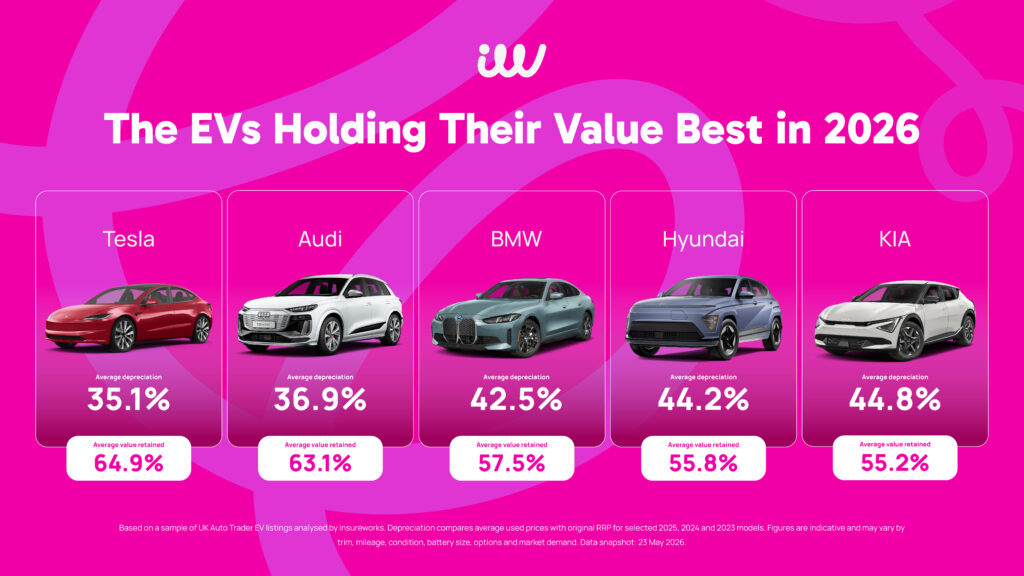
Across all brands, Tesla performed strongest overall, retaining an average of 64.9% of its original value across the Model 3 and Model Y. Audi followed with 63.1% average value retained for the Q4 e-tron.
The biggest lesson is not simply which badge sits at the top. It is that EV value retention can change quickly depending on age, model demand, battery technology, used-car supply and original purchase price. The best EV car that looks strong after one year may not hold the same position after three years, and a higher cash loss can still matter even when the percentage looks reasonable.
The EV brands holding their value best after one year
After one year, Tesla was the clear front-runner in the corrected dataset, retaining an average of 91.1% across the Model 3 and Model Y. In other words, these models had taken a much smaller first-year hit than the other EVs analysed.
That matters because the first year can be one of the sharpest points for depreciation. Nobody wants to drive off feeling smug about going electric, only to find the car’s value has quietly slipped away faster than your phone battery on 2%.
| Rank | EV brand / models analysed | Average value retained | Average cash loss |
| 1 | Tesla / Model 3 and Model Y | 91.1% | £4,205 |
| 2 | BMW / i4 | 72.2% | £14,876 |
| 3 | Volvo / EX30 | 72.0% | £10,784 |
| 4 | Audi / Q4-e-tron | 69.6% | £16,271 |
| 5 | Kia / EV6 and Niro | 65.5% | £15,213 |
| 6 | Hyundai / Kona Electric and Ioniq 5 | 64.9% | £14,309 |
| 7 | Volkswagen / ID.3 and ID.4 | 61.6% | £15,660 |
| 8 | Polestar / Polestar 2 | 60.4% | £17,919 |
The big takeaway? One-year value retention can vary massively, even between popular electric brands. Tesla’s first-year performance was especially strong, while the rest of the market showed that even nearly-new EVs can still lose five-figure sums in a short space of time.
For anyone buying brand new on finance, this is where the numbers become more than just interesting. If the car is written off early in ownership, the difference between what you paid and what it is worth at the time of claim could matter.
The EV brands holding their value best after two years
By year two, Tesla still led the table, retaining 64.8% on average. Volvo and Audi were close behind, while Polestar sat at the other end of the two-year ranking among brands with valid data.
Two years is where the picture starts to feel a bit more real for many drivers. The new-car glow has worn off, the finance agreement is still very much there, and the used market has had a bit more time to decide what your EV is really worth.
| Rank | EV brand / models analysed | Average value retained | Average cash loss |
| 1 | Tesla / Model 3 and Model Y | 64.8% | £16,190 |
| 2 | Volvo / EX30 | 62.6% | £14,423 |
| 3 | Audi / Q4-e-tron | 62.0% | £20,368 |
| 4 | Hyundai / Kona Electric and Ioniq 5 | 57.8% | £17,138 |
| 5 | Kia / EV6 and Niro | 57.1% | £18,492 |
| 6 | Volkswagen / ID.3 and ID.4 | 55.5% | £18,125 |
| 7 | BMW / i4 | 54.9% | £24,108 |
| 8 | Polestar / Polestar 2 | 50.5% | £22,236 |
The EV brands holding their value best after three years
Audi performed best after three years, retaining 57.0% of its original value on average, followed by BMW and Hyundai.
This is where the best EV car rankings become especially useful for drivers thinking about part-exchanging, refinancing or changing car after a typical ownership period. Three years is also where depreciation can start to show the difference between a car that has held steady and one that has taken a proper financial tumble.
| Rank | EV brand / models analysed | Average value retained | Average cash loss |
| 1 | Audi / Q4-e-tron | 57.0% | £23,009 |
| 2 | BMW / i4 | 45.5% | £33,573 |
| 3 | Hyundai / Kona Electric and Ioniq 5 | 44.8% | £23,610 |
| 4 | Tesla / Model 3 and Model Y | 44.0% | £29,074 |
| 5 | Kia / EV6 and Niro | 43.4% | £24,877 |
| 6 | Volkswagen / ID.3 and ID.4 | 41.2% | £24,535 |
| 7 | Polestar / Polestar 2 | 37.9% | £27,932 |
Audi’s result is a good reminder that the best-performing brand can change depending on the age of the vehicle. Tesla was strongest after one and two years, but Audi came out on top after three years in the corrected dataset.
For buyers, this means there is no one-size-fits-all answer. The “best” EV may depend on whether you plan to keep it for one year, three years or somewhere in between. Annoying? Slightly. Useful to know before signing the paperwork? Absolutely.
Best EV cars overall
Across all brands and models with full one-, two- and three-year data available, Tesla came out strongest overall, retaining an average of 64.9% of its original value across the Model 3 and Model Y. Audi followed with 63.1% average value retained for the Q4 e-tron.
Across all brands and models, these were the strongest EV brand and model groups in the dataset:
| Rank | EV brand / models analysed | Average value retained | Average cash loss |
| 1 | Tesla / Model 3 and Model Y | 64.9% | £17,367 |
| 2 | Audi / Q4-e-tron | 63.1% | £19,775 |
| 3 | BMW / i4 | 57.5% | £24,186 |
| 4 | Hyundai / Kona Electric and Ioniq 5 | 55.8% | £18,394 |
| 5 | Kia / EV6 and Niro | 55.2% | £19,582 |
| 6 | Volkswagen / ID.3 and ID.4 | 53.6% | £19,076 |
| 7 | Polestar / Polestar 2 | 49.5% | £22,729 |
Why value retention matters if your EV is written off
This is where depreciation stops being just a resale problem and starts becoming an insurance problem.
If your EV is written off or stolen, your standard motor insurer will usually base its payout on the vehicle’s market value at the time of the claim. Not what you originally paid. Not necessarily what you still owe on finance. And not always enough to buy the same car again.
A car that holds its value better may reduce the size of that shortfall. A car that drops sharply could leave a bigger gap between the motor insurance payout and the amount needed to clear finance or get back to the original invoice price. That shortfall is what GAP insurance is designed to help with, depending on the policy type and terms.
New EV or used EV: what should buyers take from the data?
For new EV buyers, stronger value retention can be reassuring. If you are planning to keep the car for a few years, the brands holding value best may help reduce the hidden cost of ownership.
For used EV buyers, the picture is different. Faster depreciation can sometimes create better value on the forecourt, because someone else has already taken the biggest hit. That does not automatically make a car good or bad. It just means the smartest choice depends on how you are buying, how long you plan to keep it and what protection you have in place.
EV buyer checklist
- Check how well the brand and model has retained value after one, two and three years.
- Look beyond the monthly finance payment and consider the likely resale value.
- Compare the cash loss as well as the percentage depreciation.
- Check battery warranty, mileage and service history on used EVs.
- Ask what would happen financially if the car was written off or stolen.
- Consider whether your motor insurance payout would be enough to clear finance or replace the car.
- Think about whether RTI GAP insurance could help cover a shortfall if the worst happened.
How GAP insurance fits into the picture
No one buys a car expecting it to be stolen or written off. But depreciation means the value of a car can move quickly, especially in a market like EVs where technology, pricing and used supply are changing fast.
RTI GAP insurance can help bridge the difference between a standard motor insurance settlement and the original invoice price of the car, subject to policy terms. For EV buyers, that can be worth considering alongside the usual checks on range, charging speed, warranty and running costs.
No scare tactics. No confusing waffle. Just a reminder that the true cost of an EV is not only what you pay each month. It is also what the car may be worth later, and what happens if you need to claim before you planned to sell it.
Disclaimer:
Insureworks analysed a sample of UK used electric vehicle listings and compared average used prices against original RRP to calculate estimated depreciation and value retention.
The dataset focused on popular electric car brands and models, including Tesla Model 3, Tesla Model Y, Audi Q4 e-tron, BMW i4, Kia Niro EV, Kia EV6, Volvo EX30, Volkswagen ID.3, Volkswagen ID.4, Hyundai Kona Electric, Hyundai Ioniq 5 and Polestar 2.
The figures should be treated as indicative market estimates rather than guaranteed resale values or vehicle valuations. Used prices can vary depending on mileage, specification, trim, battery size, condition, location, optional extras, dealer pricing and market demand. Data snapshot: 21 May 2026.
Insureworks Ltd (Firm Reference Number: 1040384) is an appointed representative of Your Company Matters Limited (Firm Reference Number: 486123) which is authorised and regulated by the Financial Conduct Authority (FCA).